Most homeowners think clogged gutters are caused by leaves.
They’re not entirely wrong.
Leaves certainly create their share of problems, but when contractors investigate recurring overflow, corner leaks, foundation erosion, and water shooting over the edge of a gutter during a storm, they often discover the real culprit isn’t the debris.
It’s the roof valley.
In fact, roof valleys are responsible for more gutter performance issues than almost any other feature on a home.
The reason comes down to one simple fact: valleys concentrate water.
Understanding how roof valleys work and why they challenge traditional gutter systems can help homeowners identify potential problems before they become expensive repairs.
What Is a Roof Valley?
A typical pine needle is between 1 and 6 inches long and as thin as 0.5 millimeters wide. That's an order of magnitude smaller than an oak leaf, and it means most gutter guard openings — designed primarily to stop leaves — are not actually small enough to stop a needle.
They fall year-round. Most deciduous debris is seasonal. You clean the gutters in November and you're mostly clear until the following fall. Pine needles don't work that way. Conifers shed needles continuously, with peak shedding usually in late summer and early fall, but real volume across every season including winter. A guard under pine cover is under constant load.
They stack and weave. This is the real killer. Pine needles are stiff enough to hold their shape but flexible enough to bend through openings, and they have a natural tendency to align with one another. Once a few needles thread through a guard opening, more needles follow the same path. The opening fills, then the gutter fills, then water sheets right over the top of the system.
This is why a guard can look perfectly clean from the ground for years while the gutter behind it is completely clogged.
Why Valleys Create More Water Flow Than Any Other Part of the Roof
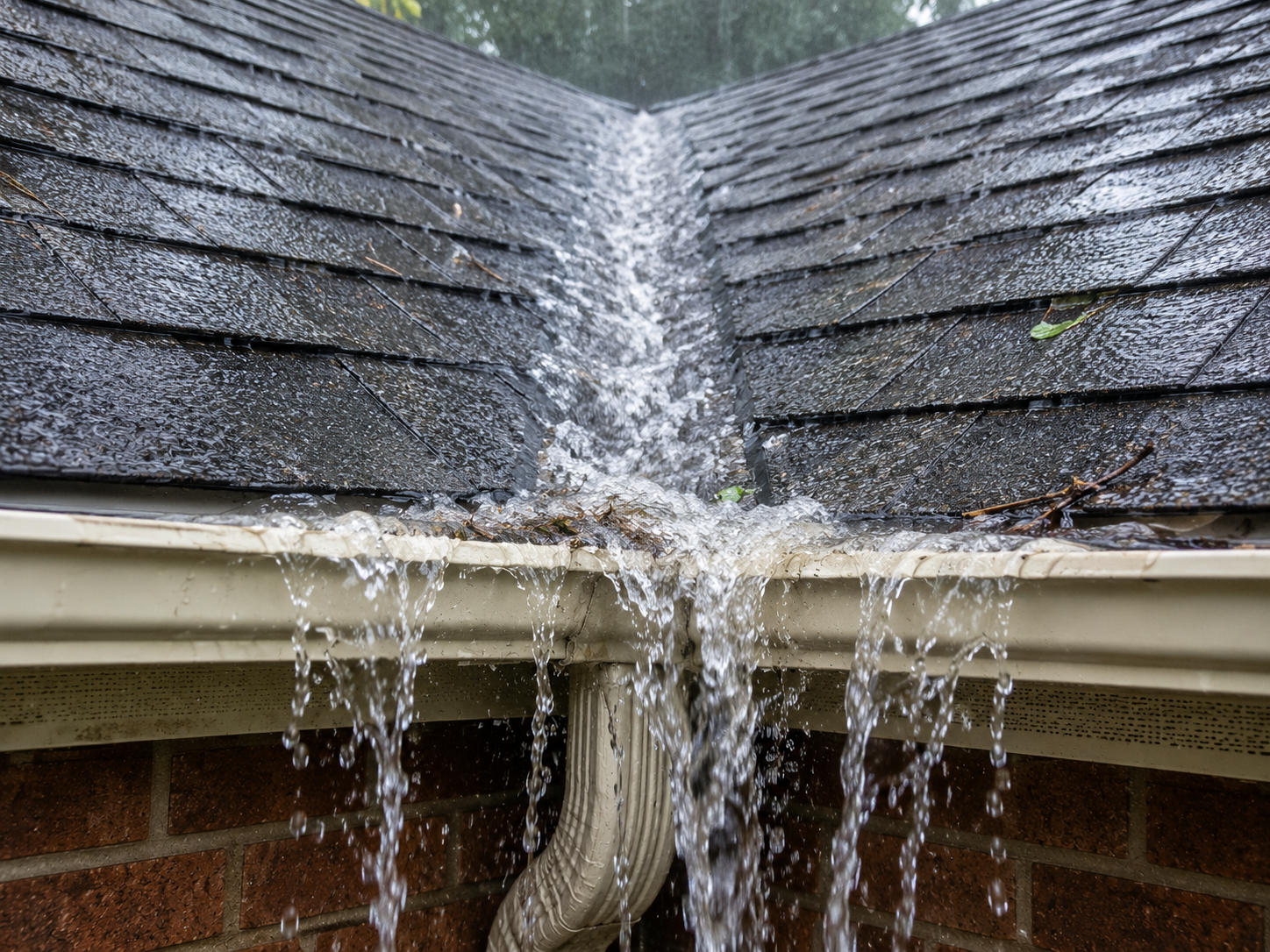
During a light rain, most homeowners never notice an issue. The gutter handles the flow without difficulty. During a heavy storm, however, the dynamics change dramatically. Water accelerates as it moves down the roof. The steeper the roof, the faster it travels.
By the time it reaches the valley, large volumes of water are moving at surprisingly high speed. When that concentrated stream enters the gutter, it often behaves more like a garden hose than rainfall.
Now imagine forcing that water to make a sharp ninety-degree turn inside a five-inch-wide gutter. That’s exactly what many standard gutter corners are being asked to do. Not surprisingly, they struggle.
The Most Common Valley-Related Gutter Problems
Corner Overflow
This is the issue homeowners notice most often. Water appears to leap over the front edge of the gutter during heavy rain. Many assume the gutter is clogged.
Sometimes it is. But many times the gutter is perfectly clean. The water simply arrives faster than the corner can redirect it.
Splashing and Overshoot
High-velocity water often overshoots the corner entirely. Instead of flowing through the gutter, it shoots past the corner and lands on landscaping, walkways, or siding below.
Foundation Erosion
A properly functioning gutter system directs water away from the home.
When valley overflow occurs repeatedly, thousands of gallons of water can be deposited near the foundation every year.
Over time this can contribute to:
- Soil erosion
- Settlement concerns
- Basement moisture
- Foundation cracks
Landscaping Damage
Many homeowners spend significant money creating attractive landscaping around their homes.
Unfortunately, concentrated water discharge can quickly undo that investment.
- Mulch washes away.
- Plants become damaged.
- Decorative stone shifts.
- Flower beds erode.
The source often traces back to an overloaded roof valley.
Why Splash Guards Became So Popular
For decades the industry’s answer to valley overflow was the splash guard. These small metal or plastic barriers attach to the front edge of the gutter and attempt to keep water from shooting over the side. They can help reduce overshoot. The problem is they often create new issues.
Debris Accumulation
- Leaves collect around splash guards.
- Pine needles become trapped.
- Seeds and roof grit accumulate behind them.
What started as a solution can become one of the first places the gutter clogs.
Increased Maintenance
Homeowners frequently discover they must clean around splash guards more often than other sections of the gutter. The corner becomes a maintenance hotspot.
Appearance
Splash guards are functional, but few people would describe them as attractive.
Many stand out visually and look like an obvious add-on rather than part of a professionally designed system.
Why Splash Guards Became So Popular
Water isn’t the only thing traveling through a roof valley. Debris follows the same path.
Leaves naturally slide toward low points on the roof. Pine needles migrate downhill.
Roof granules move with water flow. Seeds, twigs, and organic material all tend to collect in valleys. This means the area receiving the most water is also receiving the most debris. That combination creates the perfect environment for recurring gutter problems.
The Hidden Damage Homeowners Often Miss
Most gutter issues develop gradually. Homeowners rarely notice them until significant damage has already occurred.
Fascia Rot
Repeated overflow allows moisture to contact the fascia board behind the gutter. Over time, wood begins to deteriorate. Repairs often require replacing sections of fascia, repainting, and reinstalling gutter components.
Soffit Damage
Water splashing upward can eventually affect soffit materials and create opportunities for moisture intrusion.
Mold and Mildew
Persistent moisture near the roofline encourages mold and mildew growth. The problem may begin outside but eventually affect indoor air quality if left unresolved.
Basement Moisture
Many homeowners never connect basement dampness to roof drainage issues. Yet water repeatedly discharged near the foundation can contribute to moisture problems throughout the structure.
A Better Approach: Increase Capacity Instead of Blocking Water
The most effective solution is not to stop water. It’s to give water more room.
That’s the principle behind engineered gutter miters. Rather than forcing concentrated runoff through a standard corner, a properly designed miter expands the collection area where water volume is greatest.
Leaf Solution miters increase collection capacity by approximately forty percent compared to traditional corners. This gives water room to slow down, settle, and move through the gutter system more efficiently. Instead of treating the symptom, the design addresses the cause.
Why a Complete System Matters
Corner performance is only one piece of the puzzle.
The best results come from combining enhanced corner capacity with gutter protection designed to manage debris.
Leaf Solution offers three complete gutter protection systems:
Leaf Solution Micro Mesh
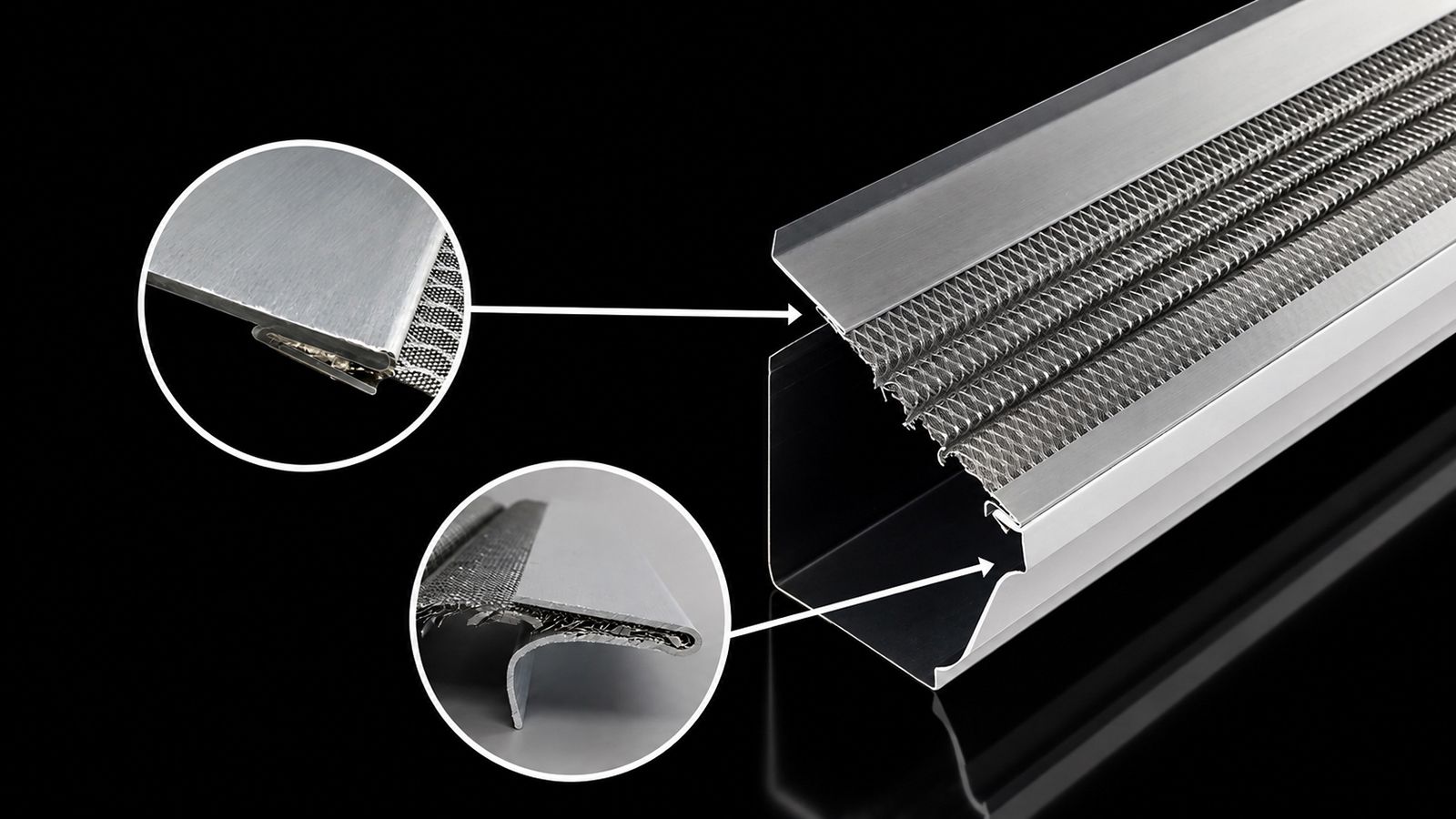
Designed with patented capillary-dip technology and stainless steel micro mesh for exceptional debris control.
Xtreme Gutter Guard
Engineered with surgical-grade stainless steel micro mesh and designed to handle heavy water flow conditions.
New Wave Gutter Guard
A durable punched-aluminum solution that offers effective protection while maintaining excellent water flow. When combined with properly engineered miters, these systems create a complete approach to managing both water and debris.
Signs Your Roof Valleys May Need Attention
Watch for these warning signs:
- Water pouring over gutter corners
- Repeated corner clogs
- Splash guards filled with debris
- Erosion beneath corners
- Water stains on siding
- Landscape washout
- Overflow during heavy rain despite clean gutters
If any of these sound familiar, the issue may not be the gutter itself. The issue may be the concentrated runoff created by the valley above it.
The Bottom Line
Roof valleys place more demand on a gutter system than any other area of the home.
- They concentrate water.
- They concentrate debris.
- They expose weaknesses in traditional gutter designs.
When they aren’t properly managed, the result can be recurring maintenance, water damage, and expensive repairs.
The good news is that these problems are preventable. A properly engineered gutter protection system combined with increased corner capacity can dramatically improve performance where it matters most. Because the goal isn’t simply to catch water. The goal is to control it.
Ready to Protect Your Home?
Whether you’re tired of cleaning gutters every season, dealing with overflowing corners, or simply want a long-term solution that protects your home, Leaf Solution offers industry-leading gutter protection systems designed to keep water flowing and debris out.
Learn More About Leaf Solution
Find a Certified Installer Near You
Explore Xtreme Gutter Guard
Explore Leaf Solution Micro Mesh
Explore New Wave Gutter Guard